Contact center artificial intelligence is changing the way businesses connect with their customers. What used to be just a place to answer calls and solve problems is now becoming a key part of business growth. With smart automation, helpful insights, and more personalized experiences, it’s clear why AI call center solutions will define the next era of business growth.
Cloud computing allows companies to store, access, and process huge amounts of customer data quickly and securely. This makes it possible for contact centers to respond in real time, handle multiple channels at once, and keep information consistent across systems. Modern computer systems and IT infrastructure make sure all of these tools work together smoothly, while big data technology helps businesses understand customer habits, predict needs, and offer better service.
AI also plays a big role in marketing. With AI-driven tools, companies can design marketing campaigns that reach the right people, personalize messages for each customer, and measure results more accurately. Digital marketing becomes smarter and more efficient, helping brands grow and maintain strong connections with their audience. In finance, AI helps businesses speed up financial tasks like tracking transactions, spotting mistakes or fraud, and making better decisions based on real-time data.
By combining cloud-based platforms, big data insights, AI-powered marketing tools, and financial automation, businesses create a connected system where contact center artificial intelligence improves every interaction. Customers get faster, more accurate help, agents work more effectively, and companies can focus on growth and innovation.
This guide explains what contact center AI is, how it works, the main benefits for your business and your customers, and practical ways to put it into action. If your goal is happier customers, lower costs, and more productive agents, contact center AI for modern business provides a clear and powerful path forward.
Top Contact Center AI Solutions for Modern Businesses
When it comes to transforming customer interactions, contact center artificial intelligence is driving efficiency, personalization, and better outcomes. Here’s a list of the top AI-powered contact center solutions to help your business deliver smarter, faster, and more connected customer experiences.
1. Bright Pattern

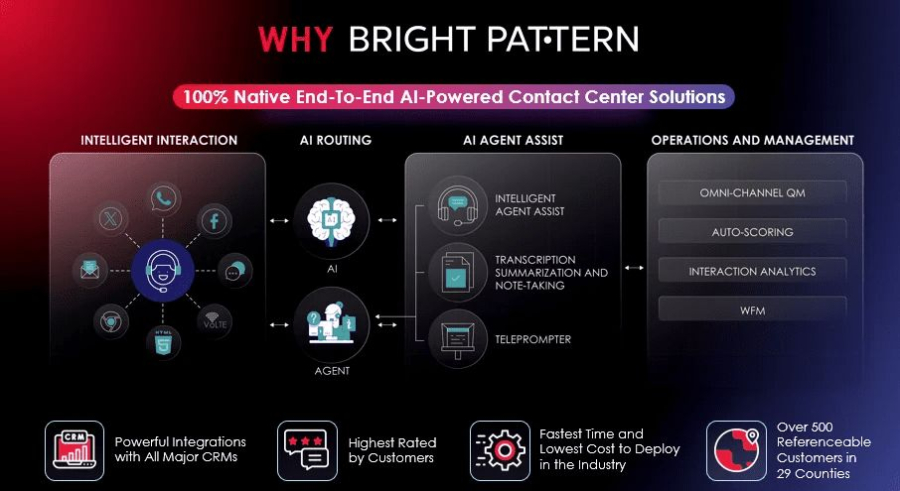
Bright Pattern is a leading provider of AI contact center solutions that seamlessly combines automation, cloud-based infrastructure, and real-time analytics. Its platform allows businesses to deliver personalized customer service across multiple channels, including voice, chat, email, and social media.
Key features of Bright Pattern include:
- Omnichannel routing powered by AI for faster response times
- Intelligent virtual agents that handle routine inquiries and reduce agent workload
- Real-time analytics and reporting for improved decision-making
- Integration with CRM, marketing, and financial systems for a unified customer experience
- Cloud-based infrastructure for scalability, security, and flexibility
Bright Pattern’s solution helps companies leverage contact center artificial intelligence to increase customer satisfaction, optimize agent performance, and drive business growth.
2. Genesys
Genesys offers AI-driven customer engagement solutions that streamline contact center operations, automate workflows, and provide predictive insights for better customer service.
3. Five9
Five9 provides cloud-based contact center software with intelligent routing, AI-powered virtual assistants, and omnichannel support to improve efficiency and customer experiences.
4. NICE inContact
NICE inContact CXone combines AI, analytics, and automation to enhance customer interactions across voice, chat, and messaging platforms.
5. Talkdesk
Talkdesk AI solutions focus on improving agent productivity, automating repetitive tasks, and delivering personalized experiences through intelligent insights and workflow automation.
6. RingCentral Contact Center
RingCentral provides AI-driven omnichannel solutions with smart routing, predictive analytics, and AI-assisted customer service to enhance operational efficiency.
7. 8x8 Contact Center
8x8 uses AI and cloud technology to deliver intelligent routing, automated support, and actionable insights for both agents and managers.
8. Avaya OneCloud
Avaya OneCloud leverages AI to optimize workforce management, improve customer engagement, and provide a unified omnichannel experience.
9. Cisco Contact Center
Cisco integrates AI-driven automation, chatbots, and analytics to streamline customer service and enhance overall satisfaction.
10. Salesforce Service Cloud
Salesforce Service Cloud combines AI, automation, and CRM integration to provide a fully connected customer service platform that delivers personalized support at scale.
What Is Contact Center Artificial Intelligence?
Contact center artificial intelligencerefers to the use of AI technologies to automate, optimize, and enhance customer interactions across channels such as voice, chat, email, and messaging. It combines automation with human support so customers can get fast, accurate help while agents handle the complex, high‑value conversations.
Typical components of contact center AI include:
- Virtual agents and chatbotsthat can handle routine questions and tasks without human intervention.
- Voicebots and conversational IVRthat understand natural language and let customers speak in their own words instead of using rigid menus.
- Natural language processing (NLP)to interpret what customers say or type and respond appropriately.
- Agent assist toolsthat suggest next best actions, answers, and knowledge articles in real time.
- Analytics and insightsthat use AI to detect sentiment, themes, and trends across interactions.
- Automation and routingthat predict intent and route customers to the right resource instantly.
Instead of replacing human agents, modern contact center AI is designed toaugmentthem: taking over repetitive tasks, providing real‑time guidance, and enabling more meaningful human connections.
Why Contact Center AI Matters Right Now
Customer expectations have never been higher. People expect fast, convenient, always‑on support and personalized experiences, regardless of the channel they use. At the same time, contact centers face pressure to reduce costs, support remote teams, and handle fluctuating demand.
Contact center AI directly addresses these challenges by combining automation and intelligence to deliver better outcomes for customers, agents, and the business.
Key Outcomes AI Drives in the Contact Center
- Higher customer satisfactionthrough faster, more accurate, and more personalized support.
- Lower cost per contactby automating high‑volume, low‑complexity interactions.
- Greater agent productivity and engagementby removing repetitive work and providing real‑time guidance.
- Improved first contact resolutionthanks to better routing, instant knowledge access, and contextual help.
- Actionable insightsthrough AI‑powered analytics that reveal trends, root causes, and opportunities for improvement.
Core Building Blocks of Contact Center AI
Contact center AI is not a single tool. It is a set of capabilities that work together to optimize both digital and voice interactions. Understanding these building blocks makes it easier to design the right strategy for your organization.
1. Virtual Agents and Chatbots
Virtual agentsandchatbotsare automated conversational interfaces that interact with customers via web chat, mobile apps, social messaging, or SMS.
They can:
- Answer common questions such as order status, billing queries, or FAQs.
- Guide customers through simple processes like password resets or appointment scheduling.
- Gather customer information before transferring to a live agent.
- Provide 24 / 7 support and handle surges in demand without adding headcount.
When powered by NLP, these virtual agents do not rely on rigid menu trees. They understand intent and can handle a wide variety of phrasings and questions.
2. Voicebots and Conversational IVR
Traditional IVR systems make customers navigate menus by pressing numbers.Conversational IVRandvoicebotsreplace that with natural language interactions. Customers can simply say what they need in their own words.
Core capabilities include:
- Automatic speech recognition (ASR)to convert speech to text.
- NLP and NLU(natural language understanding) to interpret what the caller is saying.
- Text‑to‑speechto generate natural‑sounding spoken responses.
- Integration with back‑office systemsto access account data or execute transactions.
By making the IVR experience more conversational and intelligent, voicebots shorten call times, reduce frustration, and increase self‑service success.
3. AI‑Powered Routing and Orchestration
Routing determines how customers are connected to resources. With AI, routing becomes smarter and more dynamic.
- Intent‑based routingpredicts why a customer is contacting you based on language, behavior, and history, then directs them to the best resource.
- Skills‑based routingmatches customers with agents who have the right expertise or language skills.
- Value‑based routingprioritizes high‑value customers or high‑impact issues to deliver premium service where it matters most.
The result is fewer transfers, shorter handle times, and better outcomes for both customers and the business.
4. Agent Assist and Real‑Time Guidance
Instead of expecting agents to memorize policies and knowledge articles,agent assistfeatures use AI to deliver the right support at the right moment.
Examples include:
- Suggested responsesthat recommend how to reply based on what the customer just said or typed.
- Knowledge recommendationsthat surface the most relevant articles and procedures.
- Next best actionguidance that uses customer data and policies to suggest the optimal step.
- Real‑time compliance monitoringthat flags required statements, disclosures, or missing details during the interaction.
These tools shorten onboarding time for new agents, support remote teams, and help every agent perform like a top performer.
5. Analytics, Sentiment, and Quality Intelligence
AI turns raw interaction data into powerful insights. Instead of randomly sampling a small percentage of calls or chats, AI can evaluateeveryinteraction.
- Speech and text analyticsautomatically detect topics, keywords, and emerging issues.
- Sentiment analysisgauges customer emotions and identifies points of friction.
- Automated quality monitoringscores interactions against defined standards.
- Root cause analysisreveals what is driving repeat contacts, escalations, or churn.
Leaders gain a clear, data‑driven view of performance, while frontline managers can coach more effectively with concrete examples and trends.
Top Business Benefits of Contact Center AI
Well‑designed contact center AI delivers measurable benefits across cost, experience, and employee engagement. Below are key advantages organizations typically see as they deploy AI in their customer operations.
1. Faster, More Convenient Customer Service
AI makes it easy for customers to get help the way they want, when they want.
- Instant repliesfrom chatbots for straightforward queries.
- Shorter wait timesas AI deflects or resolves a portion of contacts.
- 24 / 7 availabilitywithout needing round‑the‑clock human staffing.
- Fewer transfersthanks to smart routing and better context sharing.
All of this adds up to higher customer satisfaction and a smoother experience that keeps people coming back.
2. Higher First Contact Resolution
Because AI can access knowledge, understand intent, and route more intelligently, customers are more likely to get what they need in a single interaction.
- Virtual agents handle common issues completely end‑to‑end.
- Agent assist ensures live agents have the right answer at their fingertips.
- Analytics uncover recurring problems so they can be fixed at the source.
Higher first contact resolution means fewer repeat calls, happier customers, and lower overall interaction volume.
3. Reduced Operational Costs
Automation is a straightforward way to lower costs while improving service quality.
- Self‑service containmentreduces the number of interactions that require human agents.
- Shorter average handle timeas AI assists agents with quick lookups and suggested actions.
- Optimized staffingusing AI‑driven forecasts and scheduling.
- Lower training timebecause agents rely on real‑time support instead of memorization.
Instead of simply cutting headcount, many organizations reinvest these savings into better customer experiences and strategic initiatives.
4. Empowered, More Engaged Agents
One of the most powerful benefits of contact center AI is its impact on frontline employees. When AI handles the repetitive work, agents can focus on what humans do best: empathy, complex problem solving, and relationship building.
- New hires ramp up faster with real‑time coaching and guided workflows.
- Agents spend less time on after‑call work through automated summaries and categorization.
- They feel more confident because AI surfaces the best knowledge and next steps.
- Work becomes more meaningful as simple tasks are automated.
The result is higher job satisfaction, lower turnover, and better service quality.
5. Deeper Customer Insights and Smarter Decisions
Every interaction is a source of insight. Contact center AI turns those conversations into a living, breathing dataset that can inform decisions across the organization.
- Product teams learn what features customers love or find confusing.
- Marketing teams discover language and messaging that resonates with customers.
- Operations teams identify process issues driving unnecessary contact volume.
- Leadership gains an early warning system for emerging issues or shifting expectations.
These insights help the whole organization become more customer‑centric and agile.
Common Use Cases for Contact Center AI
Organizations across industries are already using contact center AI in practical, high‑impact ways. Below are some of the most common and effective use cases.
Customer Self‑Service and Deflection
- Handling account balance inquiries or order status checks.
- Resetting passwords or unlocking accounts.
- Updating contact information, preferences, or simple account details.
- Scheduling, rescheduling, or canceling appointments.
By automating these frequent tasks, organizations free up agents to focus on more complex or emotionally sensitive interactions.
Sales and Upsell Support
AI does not only belong in service; it also plays a powerful role in revenue generation.
- Guiding customers toward the right product or plan based on their needs.
- Recommending complementary products or add‑ons during support conversations.
- Identifying high‑value leads based on interaction patterns and sentiment.
- Alerting agents when a customer shows strong intent to buy.
With AI, every interaction has the potential to become a sales opportunity handled in a natural, customer‑friendly way.
Proactive Outreach and Notifications
Contact center AI can also help you avoid issues before they generate inbound volume.
- Sending proactive notifications about delays, outages, or changes.
- Triggering automated follow‑ups when certain events occur, such as cart abandonment or subscription renewal.
- Launching surveys and collecting feedback automatically after key interactions.
By being proactive instead of reactive, you increase customer trust and reduce preventable contact volume.
Quality Assurance and Compliance Monitoring
AI is particularly effective at enhancing quality and compliance in regulated or high‑stakes environments.
- Monitoring every call for required statements and disclosures.
- Flagging potential compliance gaps in real time so agents can correct them.
- Automatically scoring interactions for quality and coaching opportunities.
- Detecting patterns that could indicate risk, fraud, or service breakdowns.
This level of visibility was simply not practical with manual quality monitoring alone.
Key Capabilities to Look For in Contact Center AI Solutions
As you evaluate AI options for your contact center, certain capabilities make a major difference in both performance and adoption. The table below summarizes important areas to consider.
|
Capability |
Why It Matters |
|
Natural language understanding |
Accurately interpreting what customers say or type leads to better automation and fewer errors. |
|
Omnichannel support |
Ensures consistent AI behavior across voice, chat, email, and messaging channels. |
|
Integration with core systems |
Lets AI access customer data and perform real actions, not just answer FAQs. |
|
Agent assist tools |
Amplify human performance, speeding up handle time and improving accuracy. |
|
Analytics and reporting |
Turn AI interactions into insights for operations, product, and leadership teams. |
|
Configurable workflows |
Allow business teams to adjust dialogs, rules, and flows without heavy development. |
|
Security and governance |
Protect customer data and ensure AI behavior aligns with policies and regulations. |
How to Get Started With Contact Center AI
Implementing AI in the contact center works best when approached as an incremental journey, not a single big‑bang project. The following steps provide a practical roadmap.
1. Clarify Your Objectives
Begin by defining what success looks like. Common objectives include:
- Reducing average handle time or the cost per contact.
- Improving customer satisfaction or net promoter scores.
- Increasing self‑service containment and deflecting simple contacts from agents.
- Enhancing quality, compliance, or first contact resolution.
Clear goals make it easier to prioritize use cases and measure impact.
2. Identify High‑Impact Use Cases
Look for scenarios where AI can add visible value quickly. Strong candidates typically share these traits:
- High interaction volume.
- Well‑defined, repetitive tasks or questions.
- Structured processes that follow a predictable flow.
- Reliable data and clear system integrations.
Examples may include password resets, billing inquiries, order tracking, or appointment scheduling.
3. Start With a Pilot, Then Scale
Instead of trying to automate everything at once, launch a focused pilot. For example:
- Introduce a chatbot for a specific set of FAQs.
- Add agent assist suggestions for one high‑volume queue.
- Use AI analytics on a subset of recorded calls.
Gather feedback from customers, agents, and supervisors. Use these insights to refine your approach and build support for broader rollout.
4. Engage and Support Your Agents
Agents are central to AI success. When they understand how AI supports them, they become champions rather than skeptics.
- Explain clearly that AI is designed to assist, not replace, frontline staff.
- Involve agents in testing and improving AI behaviors.
- Provide training on how to work with AI tools effectively.
- Celebrate success stories where AI helped resolve difficult interactions or improve customer feedback.
A collaborative approach builds trust and ensures the technology is used to its full potential.
5. Measure, Optimize, and Expand
AI initiatives become more powerful over time as you tune and extend them. Track metrics such as:
- Self‑service containment rate.
- Average handle time and after‑call work time.
- Customer satisfaction and sentiment trends.
- Agent productivity and engagement indicators.
- Quality scores and compliance incidents.
Use these insights to fine‑tune conversation flows, routing rules, and knowledge content. As results improve, you can confidently expand AI to new channels, queues, and use cases.
Real‑World Transformation: What AI‑Enhanced Contact Centers Look Like
While every organization is different, AI‑enhanced contact centers tend to share certain characteristics that set them apart from traditional operations.
- Blended service modelswhere virtual agents handle routine tasks, and human agents focus on complex, high‑empathy interactions.
- Unified views of the customerwhere AI pulls data from multiple systems so agents see history, preferences, and context in one place.
- Continuous learning loopswhere insights from interactions inform product changes, policy updates, and training content.
- Proactive experienceswhere the organization reaches out to customers with solutions before problems escalate.
This is not just a technology upgrade; it is a transformation in how customer relationships are managed and grown.
Future Trends in Contact Center Artificial Intelligence
Contact center AI continues to evolve rapidly. Several emerging trends are poised to deliver even more value in the coming years.
More Human‑Like Conversations
Advances in language models are enabling AI systems to understand nuance, maintain context over longer conversations, and generate more natural responses. This will make virtual agents and voicebots feel increasingly conversational and capable.
Deeper Personalization
AI will become better at tailoring interactions to each individual, using past behavior, preferences, and real‑time context. Customers will experience faster resolutions and recommendations that feel uniquely relevant to them.
End‑to‑End Journey Orchestration
Rather than optimizing single interactions, AI will orchestrate entire customer journeys across marketing, sales, service, and loyalty. Contact centers will play a central role as the hub of these connected experiences.
Stronger Collaboration Between Humans and AI
The future of contact centers is not fully automated; it isaugmented. Humans and AI will work side by side, with AI handling information‑heavy tasks and humans bringing creativity, empathy, and judgment. Organizations that design for this collaboration will unlock the greatest performance gains.
Conclusion: Turning Your Contact Center Into a Strategic Advantage
Contact center artificial intelligence offers a powerful set of tools to elevate customer experience, streamline operations, and empower agents. By combining virtual agents, advanced routing, real‑time agent assist, and deep analytics, you can transform your contact center from a reactive cost center into a proactive, insight‑driven growth engine.
The most successful journeys start small, learn quickly, and scale thoughtfully. With clear objectives, a focus on high‑impact use cases, and strong engagement from your frontline teams, contact center AI can become a cornerstone of your customer experience strategy and a lasting competitive advantage.
